Work Distribution
Purpose
This spec defines how Cobre distributes computational work across MPI ranks and Rayon threads during the SDDP training loop: forward pass scenario distribution with thread-trajectory affinity, backward pass trial point distribution with per-stage synchronization, and the load balancing strategy. This spec details the distribution mechanics that Training Loop describes at the algorithmic level.
1. Forward Pass Distribution
1.1 Static Contiguous Block Assignment
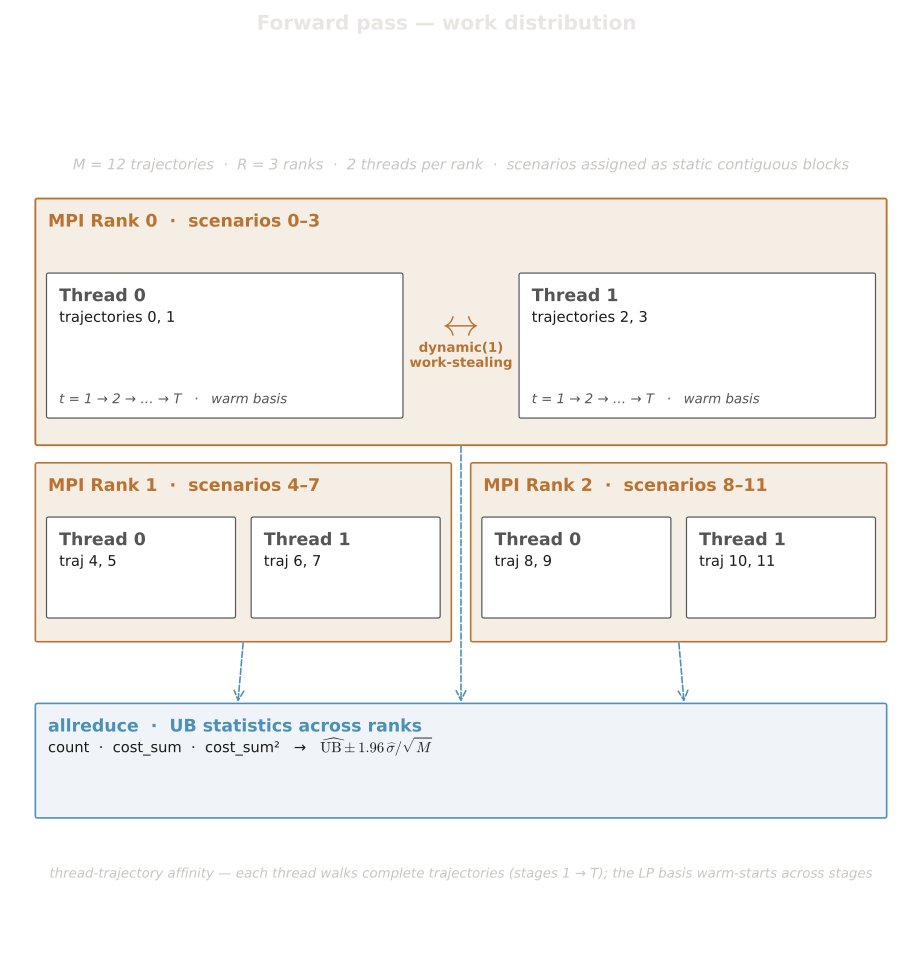
Forward pass scenarios are distributed across MPI ranks using static contiguous block assignment. Given total forward trajectories and MPI ranks, each rank receives a contiguous block of or scenario indices:
| Parameter | Value |
|---|---|
| Distribution method | Static contiguous blocks |
| Scenarios per rank | or (remainder distributed to first ranks) |
| Inter-rank communication during forward pass | None — each rank processes independently |
| Post-forward aggregation | allreduce for upper bound statistics (LB evaluated post-backward by rank 0) |
Why static, not dynamic dispatch: Forward pass scenarios have nearly identical per-stage LP solve cost (same LP structure, same cut count, same constraint dimensions). The variance in solve time comes from simplex iterations, which is small relative to the total. Static distribution avoids the complexity and latency of a dispatcher/worker protocol while achieving near-perfect load balance.
1.2 Thread-Trajectory Affinity Within Rank
Within each rank, the rank’s assigned scenarios are parallelized across Rayon threads using thread-trajectory affinity: each thread owns one or more complete forward trajectories and solves all stages sequentially ( to ) for each assigned trajectory. This preserves:
- Cache locality — solver basis, scenario data, and LP coefficients remain warm in the thread’s cache lines across stages
- Warm-start continuity — the solver basis from stage warm-starts stage within the same trajectory
- Implementation simplicity — no cross-thread data handoff during the forward pass
Decision DEC-017 (active): Communication-free parallel noise generation – every rank and thread independently derives identical noise via deterministic SipHash-1-3 seed derivation, eliminating MPI broadcast or gather for scenario noise.
Rayon distributes trajectories to threads using par_iter_mut with static partitioning. The work-stealing scheduler absorbs the small per-trajectory solve time variance while maintaining thread-trajectory affinity (each trajectory is fully executed by the thread that picks it up).
1.3 Batch Processing
When a rank’s assigned scenario count exceeds its thread count (), threads process trajectories in batches. Between batches, the thread saves and restores forward pass state (solver basis, visited states, scenario realization) at stage boundaries. See Training Loop §4.3 and SDDP Algorithm §3.4.
1.4 Post-Forward Aggregation
After all ranks complete their trajectories, a single allreduce (Communicator Trait SS2.2) aggregates:
| Quantity | Reduction | Purpose |
|---|---|---|
| Total forward cost (sum) | ReduceOp::Sum | Upper bound mean computation |
| Total forward cost (sum of squares) | ReduceOp::Sum | Upper bound variance computation |
| Trajectory count | ReduceOp::Sum | Denominator for mean/variance |
This is a single allreduce collective call with ReduceOp::Sum — no point-to-point messaging, no dispatcher coordination.
The lower bound is evaluated separately after the backward pass: rank 0 solves all stage-0 openings with the latest FCF cuts, applies the stage-0 risk measure, and broadcasts the scalar result to all ranks. See Training Loop SS4.3b.
2. Backward Pass Distribution
flowchart TB
    subgraph sT ["Stage T"]
        direction LR
        dT["distribute trial<br/>points across ranks"]
        wT["per trial point:<br/>solve N openings<br/>→ aggregate → 1 cut"]
        gT["allgatherv<br/>cuts"]
        dT --> wT --> gT
    end
    subgraph sT1 ["Stage T−1"]
        direction LR
        dT1["distribute trial points<br/><i>(incl. cuts from T)</i>"]
        wT1["per trial point:<br/>solve N openings<br/>→ 1 cut"]
        gT1["allgatherv<br/>cuts"]
        dT1 --> wT1 --> gT1
    end
    ELL(["… stages T−2 → 2 …"])
    subgraph s1 ["Stage 1"]
        direction LR
        d1["distribute trial points<br/><i>(all prior cuts available)</i>"]
        w1["per trial point:<br/>solve N openings<br/>→ 1 cut"]
        g1["allgatherv<br/>cuts"]
        d1 --> w1 --> g1
    end
    LB(["evaluate lower bound"])

    sT -->|cuts propagate backward| sT1
    sT1 --> ELL
    ELL --> s1
    s1 --> LB
Per-stage barrier: all ranks must finish stage before any rank starts . Cuts propagate backward through the stage chain.
2.1 Trial Point Collection
Before the backward pass begins, the visited states from all forward trajectories must be available to all ranks. This is accomplished via allgatherv (Communicator Trait SS2.1): each rank contributes its forward pass visited states, and all ranks receive the complete set.
The trial points are then distributed across ranks for the backward pass using the same static contiguous block assignment as the forward pass (§3).
2.2 Per-Stage Execution
The backward pass walks stages in reverse order ( down to 2). At each stage :
Step 1 — Distribute trial points: The trial points for stage (visited states from all forward trajectories) are divided across ranks using static contiguous blocks.
Step 2 — Evaluate openings: Each rank processes its assigned trial points. For each trial point, the rank evaluates all noise vectors from the fixed opening tree. Within a rank, trial points are distributed across Rayon threads via par_iter_mut, and each thread evaluates its assigned trial points’ openings sequentially — not in parallel. This sequential evaluation preserves solver warm-start across openings (the LP structure is identical, only the RHS changes between openings).
Step 3 — Aggregate into cuts: Each thread aggregates its per-opening results into cuts using the configured risk measure (expectation or CVaR).
Step 4 — Synchronize cuts: allgatherv collects all new cuts from all ranks. After this call, every rank has the complete set of new cuts for stage .
Step 5 — Update FCF: All ranks add the new cuts to stage ’s cut pool. This ensures that when stage is processed in the next loop iteration, the freshly computed cuts from stage are available (sequential backward pass using ).
Step 6 — Barrier: The allgatherv in step 4 acts as an implicit barrier — no rank can proceed to stage until all ranks have contributed their cuts for stage .
2.3 Why Sequential Opening Evaluation
The openings for a given trial point are evaluated sequentially by the owning thread (not parallelized across threads). This is a deliberate design choice:
| Concern | Sequential openings | Parallel openings |
|---|---|---|
| Solver warm-start | Preserved — same LP, only RHS changes | Lost — would require separate solver per opening |
| Memory | 1 solver per thread | solvers per thread (infeasible) |
| Cache locality | Hot — LP data stays in L1/L2 | Cold — thrashing across LPs |
| Parallelism source | Trial points across threads (sufficient) | Openings within a trial point |
With production-scale parameters ( forward passes, ranks, per rank), each rank handles trial points per stage with 48 threads — exactly 1.0 trial points per thread, achieving 100% thread utilization in the forward pass.
Forward vs. backward utilization: The forward pass achieves 100% thread utilization because . The backward pass also achieves high thread utilization: trial points are distributed across threads via
par_iter_mut, and each thread evaluates all openings sequentially for its assigned trial points (to preserve solver warm-start). With 48 trial points and 48 threads, this is 1.0 trial points per thread — ~100% thread utilization. Openings are sequential within each trial point, but trial points are parallel across threads. See Production Scale Reference §4.4 for the complete utilization analysis.
3. Distribution Arithmetic
3.1 Contiguous Block Assignment
Given items to distribute across ranks:
| Rank | Start index | Count |
|---|---|---|
This produces at most a difference of 1 between the largest and smallest block — optimal balance.
3.2 Collective Parameters
For allgatherv, each rank must know the counts and displacements for all ranks:
| Parameter | Computation | Type |
|---|---|---|
sendcount | Number of items this rank contributes | usize |
recvcounts[r] | Number of items rank contributes (§3.1) | Vec<usize> |
displs[r] | Cumulative sum of recvcounts[0..r] | Vec<usize> |
These are computed once per iteration (or once at startup if is fixed) and reused for both forward state gathering and backward cut gathering.
4. Load Balancing
4.1 Sources of Imbalance
| Source | Magnitude | Mitigation |
|---|---|---|
| LP simplex iteration count variance | Small (~5-15% per solve) | Dynamic scheduling within rank absorbs this |
| Problem heterogeneity across stages | Negligible — same LP structure per stage | None needed |
| Cut count growth across iterations | All ranks add the same cuts simultaneously | None needed — symmetric |
| NUMA memory access latency | Significant if threads cross NUMA boundaries | Addressed by NUMA-local workspace allocation (see Solver Workspaces §1) |
4.2 Why Static Distribution is Sufficient
SDDP forward pass scenarios have nearly identical computational cost because:
- Same LP structure — all scenarios at stage solve the same LP (same constraints, same variable count, same cut count). Only the RHS differs.
- Solver warm-start — all threads warm-start from the same per-stage basis cache, leading to similar iteration counts.
- No branching variance — unlike branch-and-bound, simplex iteration count variance is bounded.
The backward pass has slightly more variance (trial points at different positions in state space may require different simplex iteration counts), but this is absorbed by Rayon’s work-stealing scheduler within each rank.
4.3 Work-Stealing Within Rank
Rayon uses par_iter_mut for distributing trial points across threads within a rank. Rayon’s work-stealing scheduler statically partitions work across threads, and idle threads steal from busy threads’ queues. This means:
- Trial points are initially partitioned across threads, with idle threads stealing remaining work
- If one trial point takes longer (more simplex iterations), Rayon’s work-stealing rebalances automatically
- No explicit chunk size configuration — Rayon’s adaptive splitting provides fine-grained load balancing within the rank
This two-level approach (static across ranks, work-stealing within rank) provides optimal load balance without the complexity and latency overhead of cross-rank dynamic dispatch.
5. Design Rationale: Scenario-Based Distribution
The backward pass distributes work by scenario (trial point), not by state value. Each thread owns a set of trial points and evaluates all openings for each.
The alternative — state-based distribution — would first deduplicate trial points (multiple scenarios may visit similar states), then distribute unique states across ranks. This was rejected because:
- Warm-start loss: State-based distribution breaks the thread-trajectory affinity that makes the solver basis from the forward pass reusable in the backward pass. Without warm-start, LP solve time increases substantially.
- Synchronization cost: Collecting and deduplicating states across all ranks requires additional communication before the backward pass can begin.
- Marginal benefit: State deduplication typically saves a small percentage of LP solves — far less than the warm-start loss.
- Cache locality: Scenario-based distribution keeps each thread’s LP data in its cache hierarchy. State-based distribution would scatter work across threads with no cache affinity.
Deferred: State deduplication as an optimization (merging near-identical trial points within a rank) is documented in Deferred Features §C.17.
Deferred: Pipelined backward pass (using from the previous iteration to overlap computation with communication) is documented in Deferred Features §C.18.
Cross-References
- Hybrid Parallelism — ferrompi + Rayon architecture, static distribution across ranks, thread-trajectory affinity
- Training Loop §4.3 — Forward pass parallel distribution: contiguous blocks to ranks, thread-trajectory affinity
- Training Loop §6.2-§6.3 — Backward pass: per-stage execution, trial point distribution, allgatherv
- SDDP Algorithm §3.4 — Thread-trajectory affinity, backward sync barriers, forward pass state saving
- Solver Workspaces §1 — Thread-local solver infrastructure, per-stage basis cache, NUMA-local allocation
- Cut Management Implementation §4 — MPI cut synchronization protocol and wire format
- Scenario Generation §2.2b, §2.3, §2.3c – Communication-free noise generation work distribution (§2.2b), fixed opening tree (§2.3), parallel opening tree generation partitioning (§2.3c)
- Synchronization — Sync points, per-stage barrier semantics
- Communication Patterns — collective operations via Communicator trait
- Communicator Trait SS2 — Method contracts for allgatherv, allreduce
- Shared Memory Aggregation — Hierarchical cut aggregation within node
- Memory Architecture — NUMA-aware allocation, memory budget for per-rank resources
- Deferred Features — State deduplication (C.17), pipelined backward pass (C.18)