Convergence Monitoring
Purpose
This spec defines the Cobre SDDP convergence monitoring architecture: the convergence criteria and stopping rules, the convergence monitor’s tracked quantities and evaluation logic, bound computation including cross-rank aggregation, and the training log format for progress reporting. For the mathematical foundations, see Stopping Rules and Upper Bound Evaluation.
1. Convergence Criteria
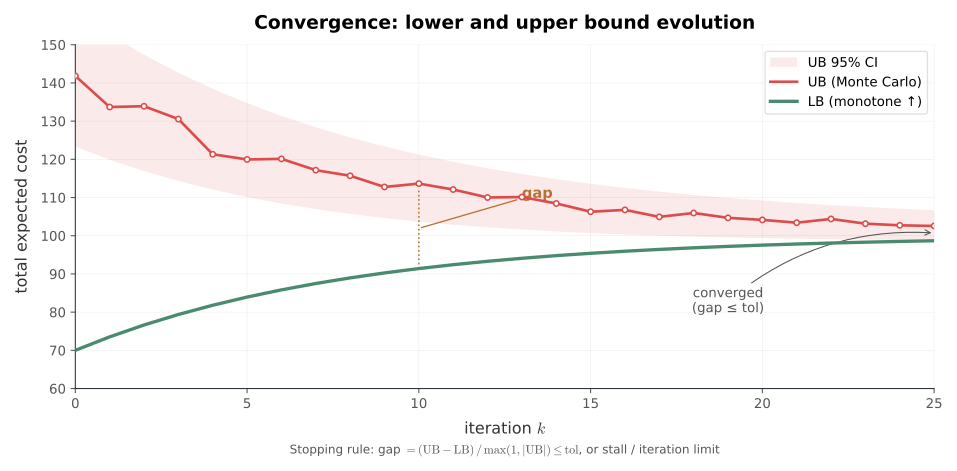
SDDP convergence is determined by the gap between lower and upper bounds on the optimal objective:
Lower Bound (LB):
- The objective value of the stage-1 LP, which includes both the immediate stage-1 cost and the future cost approximation from accumulated cuts:
- Deterministic: all scenarios share the same initial state , so the stage-1 LP is identical regardless of scenario — only one solve is needed
- Monotonically non-decreasing across iterations, since cuts only tighten the FCF approximation
Upper Bound (UB):
- Statistical estimate from forward simulation: the mean total cost across all scenario trajectories
- Includes 95% confidence interval:
- Not monotonic — depends on the scenarios sampled in each iteration
- For risk-averse policies (CVaR), the upper bound computation incorporates the risk measure weighting; see Upper Bound Evaluation
Convergence Gap:
The denominator smoothly handles the near-zero case by clamping the denominator to at least 1, matching the formula in SDDP Algorithm SS3.3. The gap is computed and logged each iteration for progress reporting, but is not itself a stopping criterion in standard SDDP — convergence is determined by the stopping rules below.
Complete tree mode note: In complete tree mode (deferred — see C.12), all scenarios from the stochastic tree are enumerated exhaustively. The upper bound becomes deterministic (exact expected cost, not a statistical estimate), and the gap becomes an exact convergence measure. In this case, a gap-based stopping criterion becomes meaningful and should be added when complete tree mode is implemented. This differs from standard SDDP where the upper bound is a noisy Monte Carlo estimate.
Stopping Rules:
The convergence monitor evaluates the stopping rules defined in Stopping Rules. The available rules and their config parameters are:
| Rule | Condition | Config Type |
|---|---|---|
| Iteration limit | Iteration count limit | iteration_limit |
| Time limit | Wall-clock time seconds | time_limit |
| Bound stalling | LB relative improvement over iterations window tolerance | bound_stalling |
| Simulation-based | Bound stable AND simulated policy costs stable (checked every period iters) | simulation |
| Graceful shutdown | External signal received (checkpoints last completed iteration) | OS signal |
Rules combine via stopping_mode: "any" (default, OR logic) or "all" (AND logic). See Stopping Rules for full mathematical definitions and configuration schema.
2. Convergence Monitor
The convergence monitor is updated once per iteration (after the backward pass, cut synchronization, and lower bound evaluation) and evaluates all stopping rules. The UB statistics come from the post-forward allreduce; the LB comes from a separate post-backward computation (rank-0 solves all stage-0 openings and broadcasts — see SS3.2).
2.1 Tracked Quantities
The monitor maintains the following per-iteration history:
| Quantity | Type | Description |
|---|---|---|
| Lower bound | f64 | Risk-adjusted aggregation of stage-0 LP objectives across all openings |
| Upper bound | f64 | Mean total forward cost across all scenarios |
| Upper bound std | f64 | Standard deviation of total forward costs |
| Gap | f64 | Relative gap |
| Iteration wall-clock time | Duration | Elapsed time for the full iteration (forward + backward + synchronization) |
2.2 Bound Stalling Detection
The bound stalling rule tracks the relative improvement of the lower bound over a configurable window. Given the bound_stalling configuration with parameters iterations () and tolerance:
The rule triggers when .
This is the same formula defined in Stopping Rules SS4. The convergence monitor maintains the bound history needed to evaluate this windowed comparison.
2.3 Convergence Evaluation
At each iteration, the monitor evaluates all configured stopping rules:
- Iteration limit — If iteration count
limit, report terminated - Time limit — If cumulative wall-clock time
seconds, report terminated - Bound stalling — If LB relative improvement over the last
iterationswindow is belowtolerance, report converged - Simulation-based — If the check period has elapsed: test bound stability, then run Monte Carlo simulations and compare to previous; if both stable, report converged. See Stopping Rules SS5
- Graceful shutdown — If an external signal flag is set, report terminated
The stopping_mode determines whether the first satisfied rule terminates (mode "any") or all must be satisfied (mode "all"). The termination reason is recorded in the training log and output metadata.
2.3a Simulation-Based Stopping Rule Integration
This subsection specifies how the simulation-based stopping rule (Stopping Rules SS5) interacts with the training loop. It resolves the execution model, workspace reuse, scenario sourcing, parallel distribution, and first-check semantics.
Execution Model
The simulation check runs synchronously — it blocks the training loop iteration. When the check period triggers (iteration is a multiple of period), the convergence monitor first evaluates bound stability. If the bound is stable, the monitor initiates a simulation forward pass before returning control to the training loop. No background or asynchronous execution occurs. This design avoids concurrent access to solver workspaces and eliminates the need for additional synchronization primitives.
The simulation check executes as part of step 5 (“Convergence update”) in the Training Loop SS2.1 iteration lifecycle.
Solver Workspace Reuse
The simulation forward pass reuses the same thread-local solver workspaces as the training forward pass (Solver Workspaces SS1). No separate LP instances are created. Each thread uses its existing solver instance, RHS patch buffer, primal buffer, and dual buffer to solve simulation scenarios exactly as it would for training scenarios. The per-stage basis cache is not updated by simulation solves — the cache retains the training iteration’s basis to preserve warm-start quality for the next training iteration.
Scenario Source
Simulation scenarios are fresh InSample draws from the fixed opening tree. At each stage, a random opening index is sampled to select the noise vector for that stage’s realization, following the same InSample mechanism as the training forward pass (Scenario Generation SS3.2).
The simulation uses a separate seed to ensure its draws are independent of the training forward pass draws for the same iteration. The simulation seed is derived as:
simulation_seed = seed_derive(base_seed + iteration, sim_scenario, stage)
where base_seed + iteration serves as the effective base seed for the simulation check at iteration , and seed_derive is the SipHash-1-3 derivation function specified in Scenario Generation SS2.2a. The addition base_seed + iteration (wrapping u64 addition) produces a base seed distinct from the training forward pass base seed for the same iteration, guaranteeing independent draws without requiring a separate seed derivation input layout.
Convention: The simulation check MUST NOT use External or Historical scenario sources. It always draws from the fixed opening tree via the InSample scheme.
Parallel Distribution
The replications simulation scenarios (typically 100) are distributed across MPI ranks using contiguous block assignment, the same distribution strategy as the training forward pass (Training Loop SS4.3). Within each rank, all Rayon worker threads participate in the simulation forward pass using the same thread-trajectory affinity pattern: each thread owns complete trajectories and solves all stages sequentially for its assigned scenarios.
Given ranks and replications, each rank processes or scenarios. After all ranks complete, a single allreduce aggregates the per-stage cost sums across ranks, yielding the global per-stage mean costs used in the normalized distance comparison.
Comparison Metric
The per-stage mean costs from the current simulation check are compared to the previous simulation check’s per-stage costs using the normalized distance formula from Stopping Rules SS5 step 2:
Convergence triggers when the bound is stable AND .
First-Check Behavior
On the first simulation check (the first iteration where the period condition triggers and the bound is stable), there is no previous simulation result to compare against. The simulation runs and stores its per-stage costs as the baseline , but does not trigger convergence. A valid distance comparison requires at least two simulation checks.
Performance Note
At production scale ( stages, replications, ranks), each rank solves approximately LP subproblems during the simulation check. Using the ~2 ms per LP solve estimate from Production Scale Reference, the wall-clock time is approximately per rank. Since all ranks execute in parallel, the total wall-clock cost of a simulation check is ~1.7 seconds — modest relative to the full training iteration time.
2.4 Per-Iteration Output Record
Each iteration produces a record with the following fields, used for logging (SS4) and output persistence:
| Field | Description |
|---|---|
iteration | Iteration index (1-based) |
lower_bound | LB value |
upper_bound | UB value (mean forward cost) |
upper_bound_std | Standard deviation of forward costs |
ci_95 | 95% confidence interval half-width () |
gap | Relative gap (informational, not a stopping criterion) |
wall_time | Cumulative wall-clock time |
iteration_time | Wall-clock time for this iteration |
3. Bound Computation
3.1 Cross-Rank Aggregation
Forward pass scenarios are distributed across MPI ranks (see Training Loop SS4.3). After the forward pass, upper bound statistics must be aggregated globally. This is done via a single MPI_Allreduce with ReduceOp::Sum that collects three sufficient statistics from each rank:
| Statistic | Per-rank value | Reduction operation |
|---|---|---|
| Scenario count | Number of trajectories solved by this rank | Sum |
| Cost sum | Sum of total costs across local trajectories | Sum |
| Cost sum-squares | Sum of squared total costs across local trajectories | Sum |
From the global aggregates, the upper bound statistics are computed:
- Mean:
- Variance (Bessel-corrected):
- Standard deviation:
- 95% CI half-width:
This single allreduce (3 doubles) is sufficient — no per-scenario data needs to be communicated. See SS3.1a for the complete aggregation protocol, numerical stability analysis, and edge cases.
3.1a Upper Bound Variance Aggregation
This subsection specifies the complete protocol for computing the upper bound mean, sample variance, standard deviation, and 95% confidence interval from distributed forward pass results. It resolves GAP-038.
Per-Rank Local Computation
After the forward pass, each rank has solved scenario trajectories and recorded their total costs . Each rank computes three local sufficient statistics:
| Statistic | Formula | Type |
|---|---|---|
local_count | u64 cast to f64 | |
local_sum | f64 | |
local_sum_sq | f64 |
Allreduce Payload
The three local statistics are packed into a contiguous [f64; 3] array in the order:
[sum, sum_sq, count]
and aggregated via a single allreduce with ReduceOp::Sum. After the reduction, every rank holds the global aggregates:
Separation from LB evaluation. The UB statistics
allreduceruns post-forward. The lower bound is evaluated separately post-backward by rank 0 (see SS3.2 and Training Loop SS4.3b).
Global Variance Formula
From the global aggregates, compute:
The denominator is Bessel’s correction, producing the unbiased sample variance. This is required because the forward pass scenarios are a sample from the underlying stochastic process, not the full population. The 95% confidence interval assumes approximate normality of the sample mean by the central limit theorem (valid for typical SDDP forward pass counts ).
Numerical Stability
The single-pass formula can suffer from catastrophic cancellation when the coefficient of variation is small — i.e., when costs are large in magnitude but tightly distributed. The relative error is bounded by:
where for f64. At production scale ( scenarios, costs , ), this bound evaluates to:
This is well within acceptable precision for convergence monitoring. The single-pass formula is the baseline. If higher numerical stability is required (e.g., for post-processing validation with extreme cost distributions), a two-pass approach (first allreduce for the mean, second allreduce for centered sum-of-squares ) can be used — but this doubles the synchronization cost and is deferred as an optimization.
Edge Case: Single Scenario ()
When , the Bessel-corrected variance involves division by . In this case:
- Set
- Set
- Log a warning that the upper bound has no statistical validity with a single scenario (no variance estimate is possible)
The upper bound mean is still valid as a point estimate but carries no confidence interval.
Cross-References
- Training Loop SS4.3b — Two-call allreduce baseline (LB
Min+ UBSum) - Convergence Monitoring SS1 — Upper bound definition and 95% CI usage in convergence gap
- Convergence Monitoring SS2.4 —
upper_bound_stdandci_95output fields consuming these computed values
3.2 Lower Bound Properties
The lower bound is evaluated after the backward pass by rank 0. Rank 0 iterates over all stage-0 openings in the fixed opening tree, solves the stage-0 LP for each opening with the latest FCF cuts (including new cuts from the current iteration’s backward pass), and aggregates the per-opening objectives via the stage-0 risk measure. The scalar result is broadcast to all ranks via comm.broadcast(). See Training Loop SS4.3b for the full algorithm.
Key properties:
- Monotonically non-decreasing — Each iteration adds cuts that can only tighten the FCF under-approximation, so
- Valid lower bound — The stage-0 objective with the current FCF under-approximates the true expected cost, so for all (under Expectation; under CVaR this is a convergence indicator — see Risk Measures SS10)
- Risk-measure-aware — The LB applies the stage-0 risk measure (Expectation or CVaR) with uniform opening probabilities, correctly handling non-Expectation risk measures
- Post-backward timing — The LB uses the latest cuts, producing the tightest available bound at each iteration. The previous forward pass UB is stale after the backward pass adds new cuts; gap comparison requires a new forward pass
3.3 Infinite Horizon Considerations
In cyclic (infinite horizon) mode, the discount factor ensures that the infinite sum of stage costs converges. The bound computation must account for this:
- Stage costs in the forward pass are discounted: the cost at stage is weighted by
- The upper bound is the mean of discounted total trajectory costs
- The lower bound naturally incorporates discounting through the variable, which carries the discounted future cost approximation
See Infinite Horizon for the mathematical treatment of discount factors in the SDDP context.
4. Training Log Format
The convergence monitor emits a structured log each iteration. The log includes a header (emitted once at training start) and per-iteration lines:
Header:
═══════════════════════════════════════════════════════════════════
Cobre SDDP Training
Case: <case_name>
Started: <timestamp>
Ranks: <R> | Threads/rank: <T> | Stages: <S> | Hydros: <H>
═══════════════════════════════════════════════════════════════════
Per-iteration line:
Iter <n> | LB: <value> | UB: <value> ± <ci_95> | Gap: <value>%
Termination summary:
═══════════════════════════════════════════════════════════════════
<TERMINATION_REASON> after <n> iterations (<reason detail>)
Total time: <elapsed> | Avg iteration: <avg>
Final LB: <value> | Final UB: <value> ± <ci_95>
Total cuts: <count> | Cuts/stage: ~<avg>
═══════════════════════════════════════════════════════════════════
The termination reason is one of: BOUND_STALLING, SIMULATION, ITERATION_LIMIT, TIME_LIMIT, or SHUTDOWN (graceful signal).
4.1 JSON-Lines Streaming Schema
When --output-format json-lines is specified, the training log is emitted as newline-delimited JSON instead of the text format above. Each line is a self-describing JSON object with a type field. The field values match the per-iteration output record defined in SS2.4.
Progress event (one per iteration):
{
  "type": "progress",
  "iteration": 1,
  "lower_bound": 1234567.89,
  "upper_bound": 1345678.9,
  "upper_bound_std": 12345.67,
  "ci_95": 2420.73,
  "gap": 0.0899,
  "wall_time_ms": 45200,
  "iteration_time_ms": 45200
}
Started event (emitted once, replaces the text header):
{
  "type": "started",
  "case": "/data/case_001",
  "stages": 120,
  "hydros": 164,
  "thermals": 130,
  "ranks": 8,
  "threads_per_rank": 16,
  "timestamp": "2026-02-25T10:00:00Z"
}
The text log and JSON-lines are mutually exclusive output modes for the same event stream. When --output-format human (default), the text log is emitted. When --output-format json-lines, the JSON-lines stream is emitted. The Parquet convergence log (training/convergence.parquet) is always written to disk regardless of output mode. See Structured Output SS3 for the complete JSON-lines streaming protocol.
4.2 Termination Event Schema
When the training loop terminates, a structured termination event is emitted (replaces the text termination summary):
{
  "type": "terminated",
  "reason": "bound_stalling",
  "iterations": 87,
  "final_lb": 72105.4,
  "final_ub": 73211.8,
  "total_time_ms": 3912000,
  "total_cuts": 16704
}
The reason field uses the same values as the text termination reason: bound_stalling, simulation, iteration_limit, time_limit, or shutdown. After the termination event, a final result event provides the response envelope for the overall command outcome. See Structured Output SS3 for the result event schema.
Cross-References
- Stopping Rules — Mathematical definitions of the stopping rules implemented by the convergence monitor
- Upper Bound Evaluation — Statistical upper bound theory, confidence interval construction, and bias corrections
- Risk Measures — CVaR risk measure, which affects upper bound computation for risk-averse policies
- Infinite Horizon — Discount factor treatment for cyclic stage graphs
- Training Loop — The SDDP training loop that invokes this convergence monitor each iteration (SS2.1 step 5 convergence update, SS4.3 forward pass distribution)
- Solver Workspaces — Thread-local solver infrastructure reused by the simulation-based stopping rule (SS1)
- Scenario Generation — Seed derivation function (SS2.2a) and InSample sampling scheme (SS3.2) used for simulation check draws
- Synchronization — MPI synchronization points including
MPI_Allreducefor convergence statistics (§1.3) - Configuration Reference — JSON schema for
stopping_rulesandstopping_mode - Structured Output — JSON-lines streaming protocol and response envelope schema
- Terminal UI — TUI convergence plot consuming the same per-iteration record